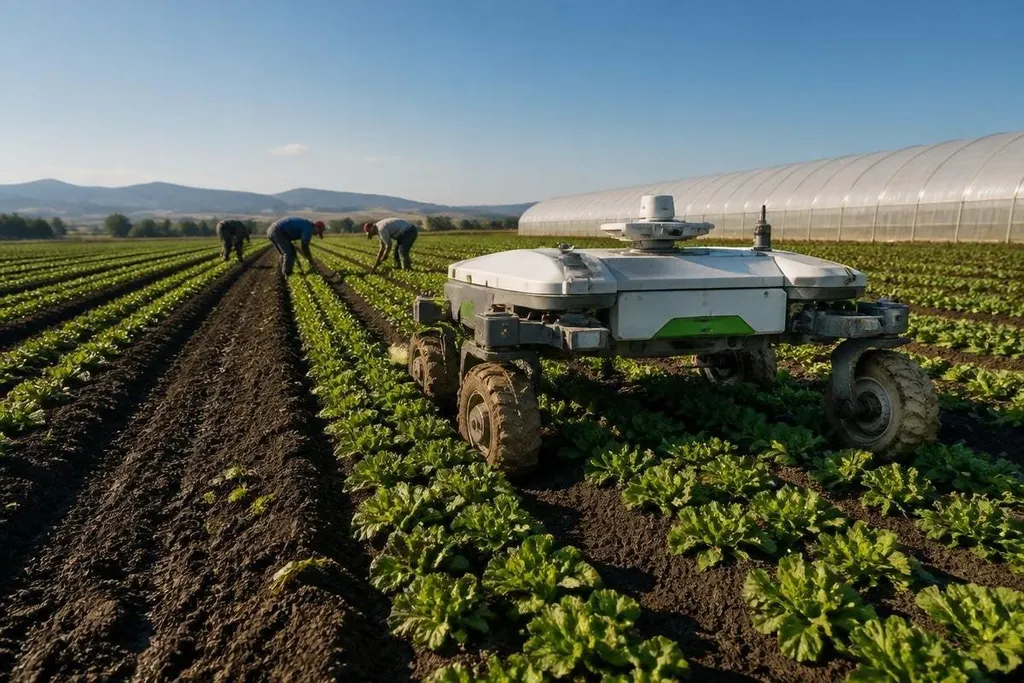
Agricultural robots are moving into fields, orchards, and greenhouses to handle work that is slow, tiring, or hard to staff. The race is not about making one robot do every farm task; it is about building machines that can work reliably around crops, mud, dust, weather, and uneven ground.
Quick read
- Crop work needs different robots for picking, weeding, spraying, and field checks.
- Cameras, LiDAR, and positioning systems help machines find plants and avoid people.
- The hard test is repeatable work across a full season, not a short field demo.
Why farm work is difficult for robots
A factory gives a robot fixed floors, known objects, and steady lighting. Conditions change by the hour. Plants grow, soil shifts, leaves hide fruit, and rain can turn a firm path into soft ground.
That forces agricultural robots to combine several systems. An RGB camera reads color and shape. A depth camera measures distance. LiDAR sends out light pulses to map nearby objects, while a positioning system helps a larger vehicle hold its route across a field.
The robot must also decide what to do with what it sees. A weed may sit beside a crop plant with leaves that look almost the same.
A picking arm must find ripe fruit without bruising it, then place that fruit in a container without dropping it.
The tasks drawing the most work
Weeding is a clear target because a robot can move between rows and remove unwanted plants with a blade, brush, or small dose of spray. The system needs accurate plant detection, since a small error can damage the crop.
Harvesting is harder. Fruit differs in size, color, and position, even on the same tree. A gripper must control force as well as movement, and the robot needs a safe route through branches and leaves.
Field scouting uses a different design. A ground robot or drone can collect images that help a grower find dry areas, damaged plants, or signs of disease. That information matters when it changes where a person waters, checks, or treats a crop.
Autonomous tractors and other large machines face another problem: safety. They need to detect people, animals, vehicles, and objects while carrying out tasks across wide areas. A stopped machine may lose time, but a machine that fails to stop creates a far larger risk.
Where the race is being won
The strongest systems will be the ones that fit into farm work without demanding a new process for every field. A robot may need to connect with existing planting plans, farm maps, charging equipment, and software used to record crop work.
This is also why reliability matters more than a single fast run. A farm operator needs to know how the robot behaves after dust reaches a sensor, a wheel slips on wet soil, or a row contains gaps that were not present in the training data.
Farm trials need more than a polished clip. Robot24.com agricultural robotics reporting can put named machines, field sites, dates, and results beside claims about farm automation, giving you a clear record before judging whether a robot keeps working as conditions change.
I’d judge an agricultural robot by the work it completes across changing field conditions, not by how smoothly one short demo looks.
What still needs proof
Many agricultural robots can identify a task in controlled conditions. Fewer have shown how they perform through a full growing season, when weather, crop growth, maintenance, and operator training all affect the result.
The business case also depends on more than the robot’s purchase price. The operator must account for batteries, spare parts, software, transport between fields, supervision, and the cost of work the robot replaces or supports.
A machine that removes weeds but needs a person beside it all day may still help on a small trial. It does not yet solve the staffing problem at a larger farm. That difference should appear in every serious comparison.
A practical buying check
Before choosing an agricultural robot, check these points:
- Name the task: Decide whether the machine weeds, scouts, picks, sprays, or carries loads.
- Check the crop: Confirm that its cameras, gripper, wheels, or tools fit the plants and row spacing.
- Test the ground: Ask how it handles slopes, mud, loose soil, standing water, and rough paths.
- Count the staff time: Record how many hours a person must spend supervising, loading, cleaning, or fixing it.
- Ask for field proof: Look for results from real farm conditions, not only indoor tests or short demonstrations.
- Price the whole system: Include service, batteries, software, transport, and replacement parts.
The next useful proof will come from robots that keep working after the field changes around them. Until growers can measure that performance across a season, the global race remains a contest of promising machines rather than finished farm tools.